

The limitations of artificial intelligence, a sustainable future, and new dimensions of human-animal relationships were among the topics discussed at the Faculty of Education for Children and Special Educational Needs at the University of Debrecen on October 6 and 7. Celebrating its fifth anniversary, the International Anthrozoology Conference hosted 71 speakers from Hungary and abroad this year, who shared their latest research findings across 14 different sessions covering almost every branch of the social and natural sciences.
News
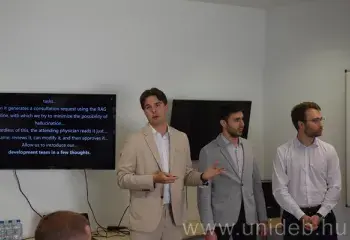
Innovative and multidisciplinary applications of artificial intelligence took center stage at the DEIK.AI Challenge 2026 student competition, organized by the Faculty of Informatics at the University of Debrecen with support from the Innovation Ecosystem Center. The finals of the first stage of this multi-stage competition—the AI Idea Competition—were held at the Faculty of Informatics.
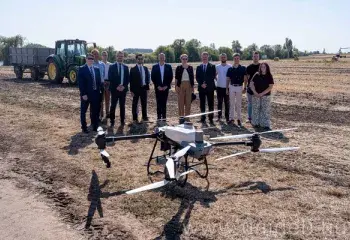
Caroline Savage, Chargé d’Affaires ad interim at the U.S. Embassy in Budapest, and Gellért Gólya, agricultural attaché, learned about precision agriculture, water management, and international research collaborations during their visit to the Látókép Crop Production Experimental Station of the University of Debrecen. The American delegation was welcomed by Rector Zoltán Bács and Endre Harsányi, Vice Rector for Strategic Development.
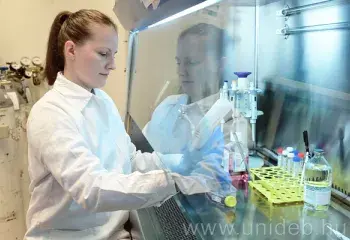
A bile acid naturally present in the body (ursodeoxycholic acid) may contribute to the growth, spread, and metastasis of ovarian tumors, according to a study by researchers at the University of Debrecen. This finding is significant because previous studies on this substance had only demonstrated anticancer effects. The research highlights that substances produced by gut bacteria can affect different types of tumors in varying ways. The researchers have received the Publication Award from the University of Debrecen and the Count István Tisza Foundation for the University of Debrecen for their paper presenting these findings.
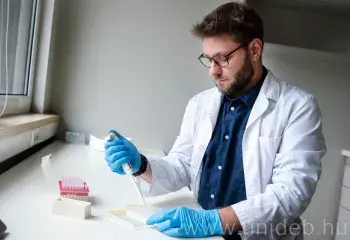
A form of vitamin D significantly reduced a dangerous inflammatory reaction associated with leukemia in laboratory studies, according to research by scientists at the University of Debrecen. This finding could lead to the development of new adjunctive treatments in the long term, but for now, vitamin D is not a substitute for life-saving steroid therapy. The researchers reported their findings in a prestigious international medical-biological journal, and their article has now been recognized with the Publication Award from the University of Debrecen and the Count István Tisza Foundation for the University of Debrecen.
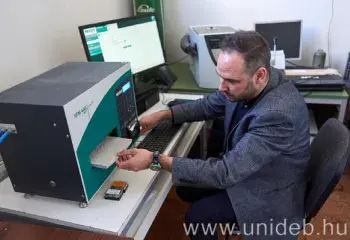
The general properties and the resistance of so-called aerogel materials, which are increasingly used in the construction, automotive, aerospace and oil industries, have been tested at the Faculty of Engineering of the University of Debrecen. The consequent findings of our researchers may contribute to further growth in the application of aerogels.

Zoltán Bács, Rector of the University of Debrecen, and Endre Harsányi, Vice Rector for Sectoral Development, held talks with senior officials of the State of Nebraska, including Secretary of State Robert Barnett Evnen, Deputy Secretary of State Cindi Allen, and the State Secretary for Food Economy, Distribution and Education of the Ministry of Agriculture and Food Economy in Hungary, László Búza. The focus of the agenda of their meeting was on further expanding our university's international network of relations and exploring new educational, research and innovation collaboration opportunities in the United States.
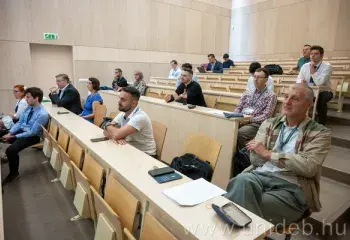
From to, to the application of AI, digital twins, and integrated modeling to climate and air quality protection, the Participants of a two-day CITDS Information Technology and Data Science Conference, hosted by the Faculty of Informatics of the University of Debrecen were able to get familiar with numerous IT innovations, including the challenges of autonomous driving, new paradigms of artificial intelligence and the application of AI, digital twins, and integrated modeling of climate and air quality protection. Once again, the central element of the event was the interaction of artificial intelligence and various technologies.
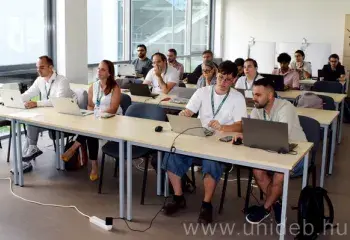
An international symposium was held at the Faculty of Informatics at the University of Debrecen on new trends in artificial intelligence, the innovative possibilities and challenges of the technology, and the significance of industry certifications and exam opportunities available in this field. At the AIDA AICET 2026 event, experts summarized, among other topics, the impact of machine learning, large language models, and agent-based systems on science.
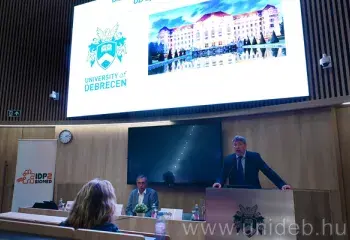
In 2026, the University of Debrecen hosted the annual meeting of the Hungarian Biochemical Society, which will be held in conjunction with an international conference. The event is the most prestigious domestic forum in the field of biochemistry, featuring scientific presentations and professional discussions, and two faculty members from the university will also receive prestigious professional recognition. The three-day conference opened on Wednesday, August 26, at the Learning Center.